The IT job market is scattered
A good vacancy can appear on a job board, in a niche Telegram group or in a chat post that disappears in an hour. Candidates who are open to work announce it in the same places. Job seekers end up checking ten sources a day; recruiters scroll through the same chats looking for people.
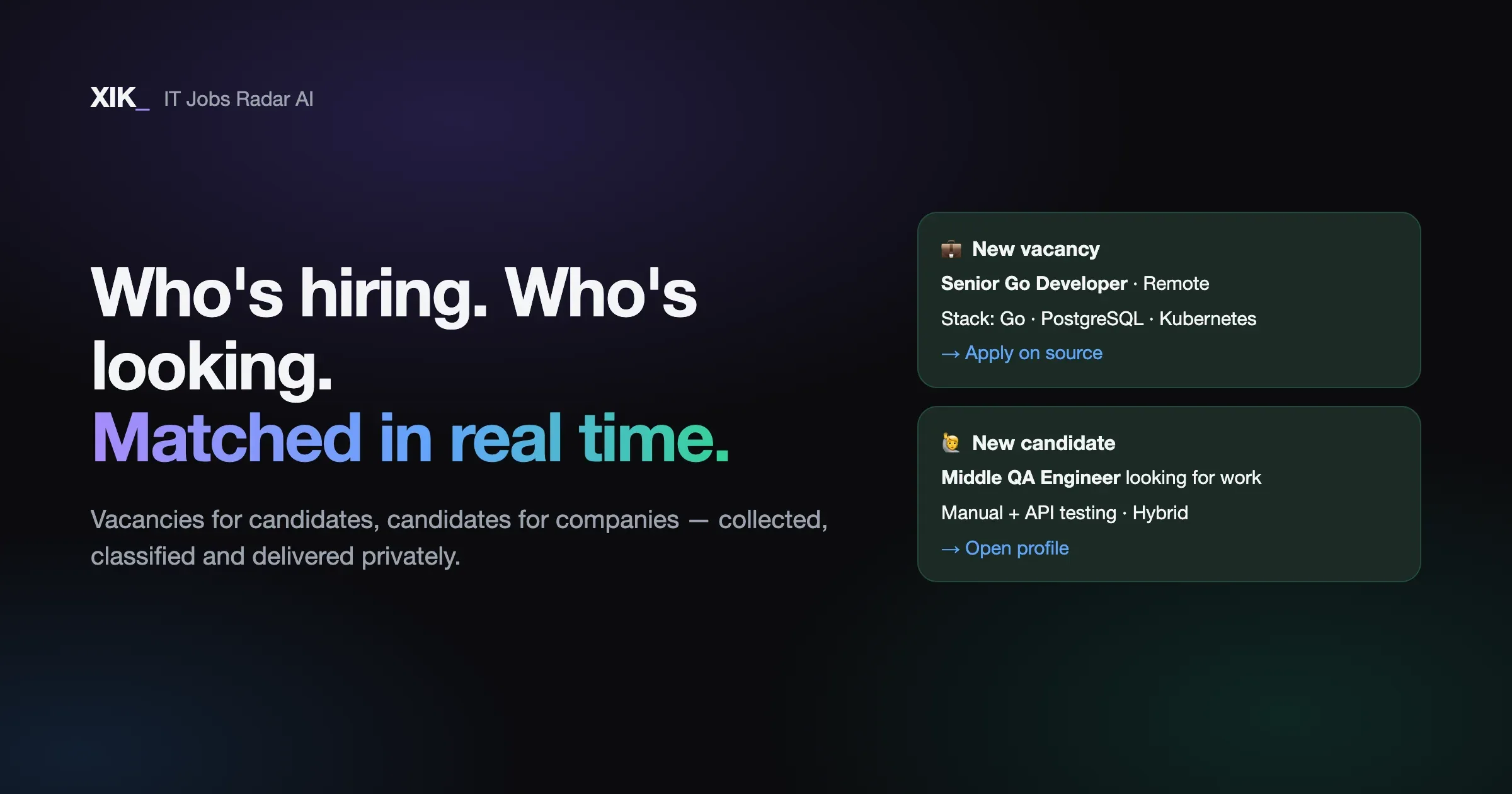
IT Jobs Radar AI watches all those places at once and works for both sides: it sends vacancies and freelance projects to people looking for work, and candidate profiles to companies that are hiring.
Where postings come from
The radar combines structured job boards — DOU, Djinni (Europe Remote) and Remotive — with IT groups and channels on Telegram, plus posts that the community submits through a structured form in the @JobItAiBot bot.
The first fetch of each new source only sets a baseline, so you never get a flood of old posts. After that every new item is deduplicated, keeps its version history when edited and expires after 30 days. When a channel deletes a post, the posting is closed too. Original source links and attribution are always kept.
Every post gets a type
Each posting is classified as a vacancy, a freelance project, a candidate profile or other. Clear cases are decided by deterministic rules. Anything uncertain lands in a single moderation queue, where an administrator can approve it, correct its type or reject it — and “other” never reaches subscribers.
Candidate profiles have a stricter bar: the post must contain an IT role or technology and first-person job-search intent. When a text sounds like an employer, the employer reading wins, so a vacancy is never mistaken for a résumé.
Two sides of one radar
For candidates — private vacancy search. Pick the technologies and tags you care about, choose whether a match needs ANY or ALL of them, and set a work mode. Remote, hybrid and onsite are detected separately from employment type, so “contract” never pretends to be “remote”. Remote searches also include posts with unknown work mode, so incomplete listings are not silently lost.
For companies — Find Talent. Recruiters receive profiles of people who explicitly say they are looking for work, with their role, stack and preferences — instead of scrolling through chats themselves.
Public channels and community submissions
Approved posts are also published to the public channels @job_it_ai and @job_it_ai_community, so the community sees new opportunities without subscribing to anything. Anyone can submit a vacancy, a project or their own profile through the bot form; every submission goes through moderation before it is published.
Hiring market intelligence
Behind the feed sits an analytics layer that shows which companies are actively hiring and which job-seeker signals are growing. It helps you decide whom to talk to — while outreach always stays human-reviewed and respects people who asked not to be contacted.
Who it is for
Developers, QA, DevOps and designers who want relevant offers to come to them instead of checking ten sites a day.
Recruiters and HR teams looking for candidates who are open to work right now.
IT companies and startups that want a steady view of the market and a channel to reach the community.
Freelancers hunting for short projects that often appear only in chats.
Share